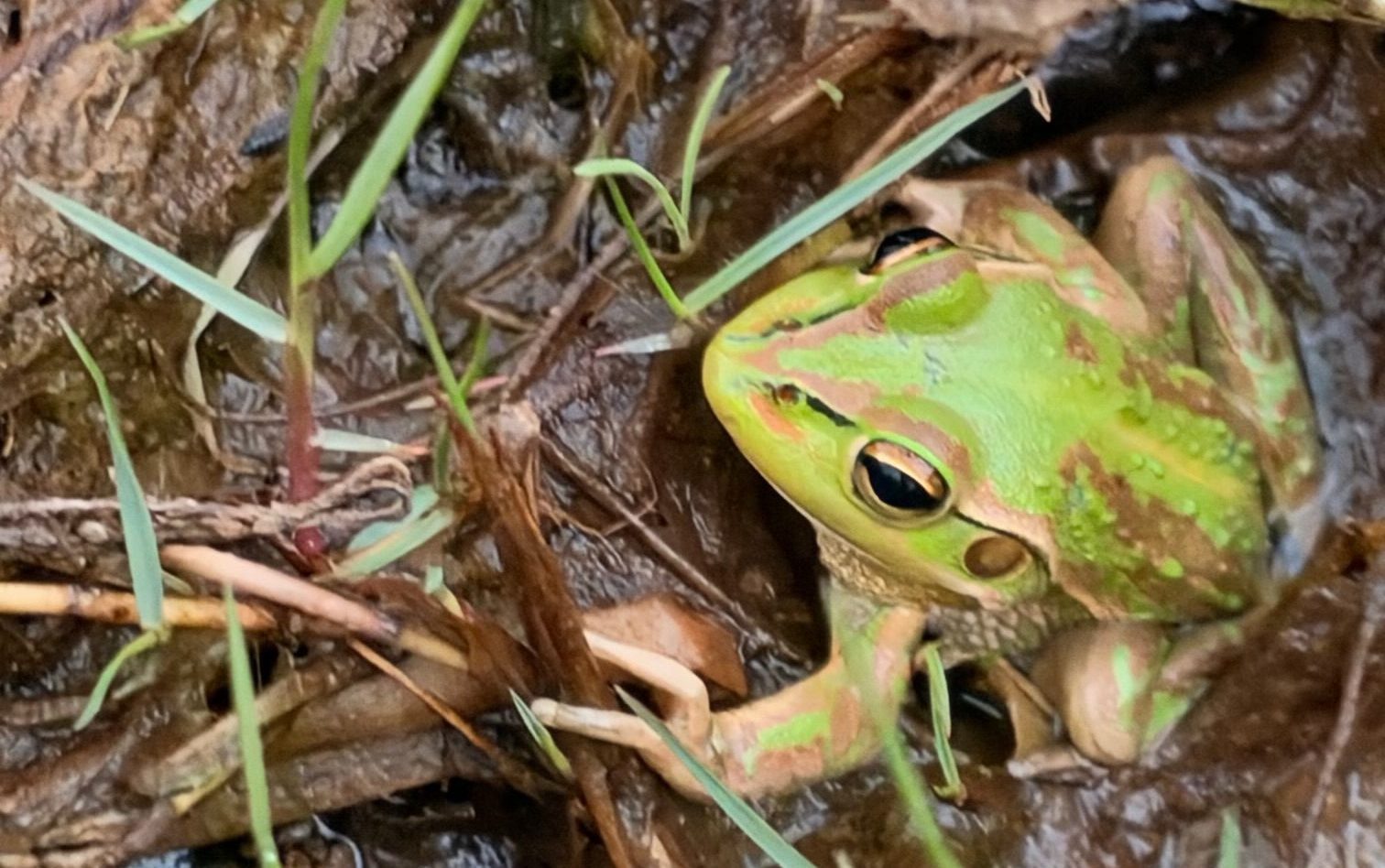
Southern bell frogs have returned to the Lower Murray for the first time in more than two decades, marking a significant milestone in efforts to restore the threatened species to the region.
The frogs disappeared from the Lower Lakes in the early 2000s after the severe and prolonged impacts of the Millennium Drought.
Earlier this month, a group of southern bell frogs was released at Investigator College’s Currency Creek EcoCentre, following years of habitat restoration, planning and collaboration.
The frogs were collected from Mutthi Mutthi Country in New South Wales, in partnership with Mutthi Mutthi and Ngarrindjeri representatives. They underwent health screening and disease management procedures before being transported to South Australia and welcomed back to Country through a cultural handover involving representatives of both Nations.
Landscapes Hills and Fleurieu general manager Michael Garrod said the return was significant for both conservation and cultural reasons.
“This moment marks the return of a threatened species to a landscape where populations have been absent for more than two decades. It is also about returning a species to Country,” he said.
The project has involved local communities, volunteers, conservation organisations, Traditional Owners, schools, researchers and government agencies.
Work to prepare the wetland for the frogs has included environmental water delivery, habitat restoration, invasive species management and captive breeding.
Ngarrindjeri Aboriginal Corporation’s Jordan Sumner said the project highlighted the shared responsibility of caring for Country.
“Seeing these frogs welcomed back to Ngarrindjeri Ruwe reminds us that caring for Country is a shared responsibility that continues across generations,” he said.
The release is part of Landscapes Hills and Fleurieu’s Back from the Brink project, supported by Nature Glenelg Trust and the Murraylands and Riverland Landscape Board.
Further releases of adult frogs, young frogs, tadpoles and spawn are planned in coming months and years, with ongoing monitoring to track their survival and breeding activity.
The ultimate goal is to establish a self-sustaining population, with researchers saying the true measure of success will be hearing the frogs calling across the Lower Lakes once again.